Why the Materials in Your Infrared Sauna Matter More Than You Think
Share
When shopping for an infrared sauna, it’s easy to focus on the obvious things: temperature, heater type, EMF levels, red light therapy, size, and all the extra features.
But there’s another detail that deserves just as much attention:
What is your sauna actually made of?
An infrared sauna is designed to be a place where you sit, breathe deeply, warm your body, and relax—often several times a week. And as the interior heats up, the materials surrounding you matter.
From the wood and adhesives to finishes and insulation, thoughtful construction can make a meaningful difference in the quality of your sauna experience.
Heat Changes the Conversation
Materials behave differently when they're heated.
Some manufactured materials, adhesives, paints, stains, and finishes can release greater amounts of volatile organic compounds (VOCs) as temperatures rise. That’s one reason it’s worth looking beyond how beautiful a sauna appears in photos and asking what was used to build it.
If creating a cleaner, more intentional home wellness environment is important to you, the materials inside your sauna should be part of your buying decision.
After all, you may be spending 20, 30, or even 45 minutes inside that enclosed, heated space.
What surrounds you matters.
Start With the Wood
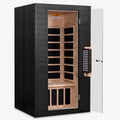
Wood is one of the biggest components of most infrared saunas, and different species have different qualities.
Canadian Hemlock
Hemlock is commonly used in quality infrared saunas because it is durable, attractive, and performs well in changing temperatures. It also tends to have a clean, understated appearance that works beautifully in modern homes.
Red Cedar
Cedar is another premium sauna material. It naturally handles heat and moisture well and is loved for its rich color and distinctive aroma.
Some people absolutely love the smell of cedar, while those who are particularly sensitive to fragrances may prefer a more neutral wood such as hemlock.
There isn't necessarily one "perfect" sauna wood for everyone. What's more important is knowing what you're buying and how it was treated.
It's Not Just the Wood
A sauna can be advertised as being made from beautiful natural wood while still containing other materials you may want to know about.
When comparing infrared saunas, consider asking about:
-
Glues and adhesives used during construction
-
Interior stains, paints, or finishes
-
Composite or engineered wood products
-
Plywood, MDF, or particleboard
-
Insulation materials
-
Chemical treatments or preservatives
Terms such as low-VOC, non-toxic, untreated, or water-based finishes can be helpful—but don't be afraid to ask manufacturers exactly what those terms mean for their products.
Transparency matters.
Why This Is Especially Important for a Home Sauna
One of the greatest benefits of owning an infrared sauna is consistency.
Instead of driving to a spa occasionally, you can make sauna sessions part of your regular wellness routine—right in your own home.
That also means you're likely to spend a lot of time inside it over the years.
Choosing a sauna shouldn't only be about finding the lowest price or the longest list of features. It's about creating a space you genuinely feel good using again and again.
Look at the whole picture:
Quality wood. Thoughtful construction. Low-EMF heating technology. Carefully selected interior materials. Reliable components. And a manufacturer willing to tell you what's actually inside their sauna.
Questions to Ask Before Buying an Infrared Sauna
Before purchasing, consider asking:
What type of wood is used?
Is it solid wood, or are composite materials used in the interior?
Is the interior wood treated?
Ask about stains, sealants, paints, and preservatives.
What adhesives are used?
Look for manufacturers that are transparent about glues and VOC considerations.
Are MDF or particleboard used anywhere in the sauna?
If so, ask where.
Does the manufacturer provide information about VOCs or material safety?
A reputable company should be willing to answer questions about construction.
What are the EMF levels?
Materials aren't the only consideration. If you're investing in an infrared sauna for regular home use, heater quality and EMF levels deserve attention too.
A Better Way to Shop for Wellness Equipment
At RevitaSpring, we believe wellness equipment should be chosen with the same care you give to the food you eat, the products you put on your skin, and the environment you create inside your home.
A sauna isn't simply another appliance.
It's a space you're intentionally creating for rest, recovery, and well-being.
So when you're comparing infrared saunas, don't stop at temperature, number of heaters, or how many bells and whistles are included.
Look a little deeper.
Ask what the sauna is made from.
Ask how it's constructed.
Ask what's being heated along with you.
Because sometimes the details you can't immediately see are the ones most worth knowing.
The RevitaSpring Difference
We believe bringing wellness into your home should feel good from beginning to end. That's why we're intentional about the products we offer and the manufacturers we work with.
Our goal isn't simply to help you buy an infrared sauna.
It's to help you choose one you'll feel confident bringing into your home—and excited to use as part of your everyday wellness routine.
Because the best sauna isn't necessarily the one with the longest feature list.
It's the one you feel good stepping into every single day.