Red Light Therapy Wavelengths Explained: What Science Says About Different Colors of Light
Share
Red Light Therapy Wavelengths Explained: What Science Says About Different Colors of Light
From blue light and visible red light to near-infrared wavelengths, discover what researchers are studying, why the numbers matter, and how to choose the right light therapy device for your home.
If you've ever compared two red light therapy devices, you've probably noticed something interesting.
One advertises 660nm and 850nm. Another includes 630nm, 810nm, and 830nm. Then you come across a panel with seven or nine wavelengths, or an infrared sauna with blue, red, deep-red, and near-infrared light built right into the cabin.
Suddenly, choosing a wellness device starts to feel like studying for a science exam.
What do all those numbers mean?
Is 850nm better than 660nm? Does blue light do something different from red light? And if an infrared sauna already has light therapy, do you really need a separate red light panel?
These are great questions.
At RevitaSpring, I believe understanding what you're bringing into your home is just as important as choosing something beautiful or convenient. So rather than telling you that one wavelength is the best for everything, I want to walk you through what the research actually tells us.
Some light wavelengths have been studied extensively for specific applications. Others are still being investigated. And while the science behind photobiomodulation is fascinating, it's important to understand that the wavelength alone doesn't determine whether a treatment will work.
Let's explore the science, one color at a time.
What Is a Light Therapy Wavelength?
Light travels in electromagnetic waves. The distance between successive peaks of those waves is called the wavelength, and it's measured in nanometers (nm).
A nanometer is one-billionth of a meter.
Different wavelengths correspond to different parts of the electromagnetic spectrum. Some are visible to our eyes, while others are invisible.
In light therapy, the wavelengths we're most interested in generally fall into three groups:
-
Blue light: Approximately 400–500nm, often studied for surface-level skin applications.
-
Visible red light: Approximately 620–700nm, frequently studied in skin-focused photobiomodulation.
-
Near-infrared light: Approximately 700–1,400nm, investigated for a variety of applications involving tissues beneath the skin.
Those boundaries aren't rigid biological dividing lines. They are useful ways to organize the spectrum.
You'll also encounter yellow light, deep-red light, and far-infrared heat in certain wellness devices.
Each deserves a little explanation.
What Is Photobiomodulation?
Photobiomodulation, often abbreviated PBM, refers to the use of specific wavelengths of light to influence biological processes.
Unlike ultraviolet light, which can damage cellular DNA, the red and near-infrared wavelengths typically used in PBM are non-ionizing.
Researchers have studied how these wavelengths interact with cellular molecules, including components of the mitochondria, and how they may influence signaling pathways related to cellular metabolism, oxidative balance, and inflammatory responses.
One frequently discussed mechanism involves cytochrome c oxidase, an enzyme in the mitochondrial respiratory chain. However, the precise mechanisms differ across wavelengths and experimental conditions and are not completely understood.
The important thing to understand is that photobiomodulation isn't simply about shining a bright light on the body.
The wavelength, intensity, dose, exposure time, treatment distance, and tissue being targeted all matter.
That helps explain why two devices with the same advertised wavelengths may not deliver the same results.
Blue Light: 415nm, 450nm, 455nm, and 480nm
What is blue light being studied for?
Blue light has received considerable attention in dermatology, particularly in research involving acne.
Certain compounds called porphyrins, produced by Cutibacterium acnes bacteria, can absorb specific blue-light wavelengths. This process may produce reactive oxygen species that affect the bacteria.
Clinical studies of blue-light devices have reported improvements in some acne outcomes, but results vary, and the evidence depends on the wavelength, device, treatment protocol, and severity of acne.
An important distinction: 415nm blue light has been studied more directly for acne than some longer blue wavelengths such as 455nm or 480nm.
That means we shouldn't automatically assume every blue-light LED produces the same clinical effects.
Where blue light appears at RevitaSpring
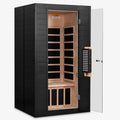
The Wizzisaunas S01 Infrared Sauna includes a 455nm blue-light wavelength within its four-wavelength system.
The Total Spectrum MAX Red Light Therapy Panel incorporates 480nm blue light alongside red and near-infrared wavelengths.
These offer different ways to incorporate blue light into a broader wellness routine, although neither should be assumed to reproduce the results of a specific clinical acne-treatment device.
A note about blue light and skin safety
More blue light isn't necessarily better.
Visible blue light can contribute to pigmentation changes in susceptible skin, especially at higher exposures, and people with photosensitive conditions may need additional caution.
Blue-light therapy also isn't the same as looking at a bright blue screen. The wavelength, intensity, exposure, and intended application are different.
For someone primarily interested in acne, I would recommend speaking with a dermatologist rather than choosing a device solely because its specification sheet includes blue LEDs.
Yellow Light: Around 590nm
Yellow light is another wavelength that appears in some advanced multi-spectrum panels.
Research has explored approximately 590nm light in dermatological settings, including studies involving skin appearance and photoaging.
However, the clinical evidence for yellow-light therapy is more limited and less standardized than the research supporting certain red and near-infrared applications.
You may see claims that yellow light reduces redness, improves circulation, or brightens skin. Some of those ideas are being investigated, but they shouldn't be treated as guaranteed outcomes.
Where to find yellow light at RevitaSpring
The Vital Ultimate Full-Body Red Light Therapy Panel includes 590nm yellow light as part of a nine-wavelength system.
For shoppers who enjoy having several wavelength options available, a multi-spectrum panel can provide additional flexibility.
Just remember that more wavelengths don't automatically mean better results.
Red Light: 630nm and 660nm
Now we're getting into the wavelengths most people associate with red light therapy.
If you've spent any time researching LED masks, skincare panels, or home photobiomodulation devices, you've probably seen 630nm and 660nm repeatedly.
There's a reason for that.
Visible red light has been studied in dermatology for applications involving skin appearance, wound healing, and other tissue responses.
What does research say about red light and skin appearance?
A randomized controlled clinical trial published in Photomedicine and Laser Surgery in 2014 evaluated red and near-infrared light treatments for skin rejuvenation.
The researchers reported improvements in several measures of skin appearance, including skin roughness and collagen-related outcomes, in the treatment groups.
The results were encouraging, although they don't mean every red light device will produce identical changes.
Different devices can deliver very different doses, even when they use similar wavelengths.
For someone interested in maintaining healthy-looking skin, this is one of the more relevant areas of photobiomodulation research.
Is 630nm better than 660nm?
Not necessarily.
Both fall within the visible red range and are used in photobiomodulation research.
The differences in tissue absorption and penetration may influence how they perform in particular settings, but there's no universal clinical rule that 630nm is best for skin while 660nm is best for something else.
That kind of simplified wavelength chart may be convenient, but it often makes the science sound more certain than it is.
I would focus on the quality of the device, the published output measurements, and the treatment protocol rather than choosing based on a 30nm difference alone.
RevitaSpring devices featuring 630nm and 660nm
For a flexible at-home option, the Vital Elite Full-Body Red Light Therapy Panel combines 630nm and 660nm red light with 830nm and 850nm near-infrared light.
The Total Spectrum COMPACT also includes both red wavelengths, along with additional blue and near-infrared options.
These devices may appeal to people who want to explore red and near-infrared light without purchasing separate equipment for every wavelength.
Deep Red Light: 670nm and 734nm
Deep-red wavelengths sit near the transition between visible red light and near-infrared light.
You may encounter 670nm in photobiomodulation research and 734nm in certain multi-wavelength wellness devices.
What is 670nm being studied for?
Researchers have explored 670nm light in experimental work involving mitochondrial responses, visual function, and other biological processes.
Some small human studies have reported changes in specific visual-function measurements, but the evidence remains preliminary.
This is especially important because eye-related photobiomodulation research involves carefully controlled exposure protocols.
A general-purpose red light panel should never be used as an improvised eye treatment.
What about 734nm?
The 734nm wavelength is less extensively represented in high-quality human clinical research than common wavelengths such as 660nm, 810nm, or 830nm.
Its inclusion in a device may broaden the emitted spectrum, but there isn't strong evidence that 734nm has a unique, proven wellness benefit unavailable from nearby wavelengths.
Deep-red light in RevitaSpring saunas
The Wizzisaunas S07 2–3 Person Infrared Sauna includes 734nm deep-red light alongside 455nm blue, 658nm red, and 850nm near-infrared light.
That makes it an interesting choice for someone who wants a spacious infrared sauna with an integrated multi-wavelength light system.
I especially like the idea of having heat and light therapy available in the same home wellness space, while recognizing that research on each technology needs to be evaluated separately.
Near-Infrared Light: 810nm, 830nm, and 850nm
Near-infrared light is invisible to the human eye.
This is where light therapy becomes particularly interesting because certain near-infrared wavelengths can travel farther into tissue than many visible wavelengths.
But that doesn't mean light reaches every muscle or joint at the same intensity.
As light passes through skin and tissue, it is absorbed and scattered. The amount that reaches a particular depth depends on the wavelength, skin and tissue characteristics, device output, and treatment geometry.
810nm: Cellular and neurological research
The 810nm wavelength has been investigated in several areas of photobiomodulation, including neurological and musculoskeletal research.
Researchers have studied transcranial photobiomodulation, where near-infrared light is applied to the head under controlled experimental conditions.
Early clinical investigations have explored cognition, mood, and neurological function, but findings are not yet sufficient to recommend consumer light therapy devices as treatments for neurological or psychiatric disorders.
This is a promising research area, not an established home treatment.
830nm: Skin and tissue research
The 830nm wavelength appears in studies of skin responses, wound healing, and other tissue-related applications.
It has also been combined with visible red light in dermatological studies.
Researchers are interested in its penetration characteristics and its potential to influence biological signaling.
Still, evidence from a specialized clinical device doesn't automatically transfer to a consumer panel using the same wavelength.
850nm: A common near-infrared wavelength
If you've been shopping for red light therapy, you've almost certainly encountered 850nm.
It is widely included in consumer red light panels and combined red/NIR devices.
Near-infrared photobiomodulation has been investigated for exercise recovery, musculoskeletal discomfort, and tissue responses.
Some controlled studies and systematic reviews report encouraging findings in particular settings. Others show mixed or inconclusive results.
That's why I would describe 850nm as a well-established wavelength in photobiomodulation equipment, rather than a wavelength proven to eliminate soreness or repair joints.
Do you need all three wavelengths?
Not necessarily.
A well-designed device using one or two near-infrared wavelengths may be entirely appropriate for its intended application.
Multi-wavelength devices offer versatility, but the total light dose, spectral output, treatment distance, and consistency of use are just as important.
Near-infrared options at RevitaSpring
The Total Spectrum ULTRA Full-Body Red Light Therapy System combines 810nm, 830nm, and 850nm with visible red and other wavelengths.
Its adjustable stand can accommodate different positions, making it especially interesting for a dedicated home wellness room.
For a smaller option, the Vital Charge Portable Red Light Therapy Device includes 810nm and 850nm alongside 630nm and 660nm.
And if you prefer combining your light routine with infrared heat, several RevitaSpring saunas incorporate 850nm near-infrared LEDs.
What About 1060nm and 1064nm?
Some newer multi-spectrum panels include wavelengths around 1060nm or 1064nm.
These are also within the near-infrared spectrum.
Research has explored light near 1064nm in certain experimental and clinical settings, including neurological photobiomodulation.
But it's important not to confuse a consumer LED emitting around 1064nm with a clinical laser using the same nominal wavelength.
The devices may differ dramatically in intensity, beam characteristics, exposure, and intended application.
Also, 1064nm is not automatically the deepest-penetrating or most effective wavelength for every tissue. Biological absorption and scattering do not follow a simple rule that higher wavelength numbers are always better.
RevitaSpring's Total Spectrum MAX and Total Spectrum ULTRA both include 1064nm as part of their seven-wavelength configurations.
These are interesting options for shoppers who want a broad range of wavelengths, provided their expectations remain grounded in what the research actually supports.
Infrared Sauna Heat vs. Near-Infrared Light Therapy: Are They the Same Thing?
This is one of the most important distinctions in the entire article.
An infrared sauna and a red light therapy panel both use light-related technology, but they aren't interchangeable.
Infrared saunas primarily use infrared radiation to deliver heat.
Far-infrared heating systems emit wavelengths substantially longer than the red and near-infrared LEDs commonly used in photobiomodulation.
Their primary effect is thermal: they warm the body.
Red light therapy panels, on the other hand, are generally designed to deliver specific optical wavelengths at measured intensities for photobiomodulation.
A sauna's far-infrared heater does not automatically provide the same exposure as a dedicated 850nm LED panel.
That's why integrated light therapy is an important feature to look for if you want both experiences.
Combining infrared heat with dedicated light therapy
The Neptune Full Spectrum Infrared & Red Light Therapy Sauna combines near-, mid-, and far-infrared heating with a dedicated 660nm red and 850nm near-infrared lamp.
The Wizzisaunas S02 2-Person Infrared Sauna uses far-infrared heating panels and a separate four-wavelength light therapy system.
I think this combination is especially appealing from a lifestyle perspective.
You can enjoy the warmth and quiet of a sauna while also having access to a dedicated light therapy feature.
However, we should be careful about claiming that combining the two automatically produces superior clinical outcomes. More research is needed to establish whether simultaneous use offers benefits beyond each technology used separately.
Does More Light Mean Better Results?
Not always.
This is where photobiomodulation becomes a little counterintuitive.
In some laboratory and clinical research, light responses follow what's called a biphasic dose response.
In simple terms, too little light may produce no meaningful response, while increasing the dose beyond a useful range may not improve results and could reduce the desired response.
That means choosing the most powerful device and using it for the longest possible time isn't necessarily a smart approach.
What is irradiance?
Irradiance describes the amount of optical power reaching an area, usually expressed in milliwatts per square centimeter (mW/cm²).
What is fluence?
Fluence, sometimes called radiant exposure, describes the energy delivered per area over time, usually measured in joules per square centimeter (J/cm²).
For a steady exposure, the simplified relationship is:
Dose (J/cm²) = Irradiance (mW/cm²) × Time (seconds) ÷ 1,000
But even that calculation doesn't tell the whole story.
Measurements can vary by distance and testing method, and the energy reaching the surface isn't necessarily the energy reaching deeper tissue.
That's why I recommend looking for clearly documented output specifications and following the manufacturer's instructions rather than inventing a universal treatment schedule.
Which Wavelength Should You Choose?
Let's make this practical.
If your main interest is skin appearance, visible red wavelengths such as 630nm and 660nm are a reasonable place to begin your research.
If you're interested in exercise recovery or musculoskeletal photobiomodulation research, near-infrared wavelengths such as 810nm, 830nm, and 850nm are particularly relevant.
If you're researching blue light for blemish-prone skin, pay attention to the exact wavelength and clinical evidence rather than assuming all blue LEDs are equivalent.
And if your goal is to create a relaxing home wellness ritual with both heat and light, an infrared sauna with a dedicated photobiomodulation system may be worth considering.
But remember that no wavelength is a guarantee of a particular health outcome.
Your intended use, the quality of the device, treatment instructions, and the actual evidence should guide your decision.
Should You Buy a Red Light Panel or an Infrared Sauna With Light Therapy?
I don't think one is universally better.
They're designed around different experiences.
A dedicated red light therapy panel may be a better fit if:
-
You primarily want a light-focused routine.
-
You want more flexibility in treatment positioning.
-
You're interested in several red and near-infrared wavelengths.
-
You want to use light therapy without the heat of a sauna.
-
You have a smaller space or want a portable option.
You can explore the RevitaSpring Red Light Therapy Collection to compare different sizes and wavelength configurations.
An infrared sauna with integrated light therapy may be a better fit if:
-
You already enjoy sauna sessions.
-
You want infrared heat and light therapy available in one place.
-
You're creating a dedicated home wellness space.
-
You value the comfort and relaxation of a sauna environment.
-
You prefer an integrated setup rather than multiple separate devices.
Some options worth exploring include the Wizzisaunas S01, Wizzisaunas S07, and Neptune Full Spectrum Sauna.
What if you want both?
That's perfectly reasonable, too.
A dedicated panel may offer greater positioning flexibility, while a sauna creates an entirely different experience centered on warmth and relaxation.
I would simply avoid assuming that doubling up on exposure automatically improves outcomes.
Follow the instructions for each device, and be mindful of total exposure and heat tolerance.
Frequently Asked Questions About Light Therapy Wavelengths
What is the best wavelength for red light therapy?
There is no single best wavelength for every purpose. Commonly studied red wavelengths include 630nm and 660nm, while 810nm, 830nm, and 850nm are frequently used in near-infrared photobiomodulation. The most appropriate wavelength depends on the intended application and treatment protocol.
What is the difference between 660nm and 850nm?
660nm is visible red light, while 850nm is invisible near-infrared light. They have different absorption and penetration characteristics and are often combined in photobiomodulation devices.
Is 850nm better than 660nm?
Not universally. A wavelength that is useful in one experimental or clinical setting may not be optimal for another. Greater tissue penetration alone doesn't establish better results.
What does 455nm blue light do?
Blue light near 455nm is included in some multi-spectrum devices. Blue-light research includes dermatological applications, especially acne, but much of the acne-specific evidence involves wavelengths closer to 415nm. Results shouldn't be assumed identical across the entire blue spectrum.
Is 830nm good for skin?
830nm has been studied in dermatological photobiomodulation, including applications involving skin and tissue responses. Outcomes depend on the specific device and exposure protocol.
Do infrared saunas provide red light therapy?
Not automatically. Infrared sauna heaters primarily provide thermal energy. A sauna needs a dedicated red or near-infrared photobiomodulation system to offer the type of light therapy discussed in this guide.
Can red light therapy be used every day?
Some device protocols involve frequent use, but there is no universal schedule appropriate for every wavelength, intensity, or application. Follow your device's instructions and seek professional guidance when using light for a medical concern.
Is red light therapy safe for the eyes?
Do not stare directly into high-intensity LEDs or lasers. Follow device-specific eye protection guidance. Light therapy intended for the eyes requires specialized protocols and professional oversight; ordinary consumer panels should not be used to self-treat eye conditions.
Does red light therapy contain UV light?
Red and near-infrared light are different from ultraviolet light. Many red light therapy panels are designed to be UV-free, but verify the specifications of the particular device.
Final Thoughts: Understanding the Light Behind Your Wellness Routine
What I find most fascinating about light therapy is that something as familiar as light can be studied in such specific and sophisticated ways.
A difference of a few dozen nanometers can change how light interacts with tissue.
But it's also easy to get caught up in the numbers and forget the bigger picture.
You don't need every wavelength available.
You don't necessarily need the largest panel.
And you certainly don't need a product that promises to solve every health concern imaginable.
What you need is good information, a thoughtfully designed device, and realistic expectations about what the science does—and doesn't—tell us.
That's the approach I want to bring to RevitaSpring.
Whether you're exploring a compact red light therapy device, considering a full-body panel, or dreaming about an infrared sauna with integrated light therapy, I want you to feel confident understanding what you're buying.
Because creating a restorative space at home should feel empowering, not overwhelming.
Explore RevitaSpring's Red Light Therapy Collection, or discover our infrared saunas with integrated light therapy to find an option that fits your space and the routine you want to create.
Educational disclaimer: This article is for general educational purposes and is not medical advice. Research findings from clinical photobiomodulation devices cannot automatically be generalized to consumer wellness products. RevitaSpring's general wellness devices are not intended to diagnose, treat, cure, or prevent disease. Consult a qualified healthcare professional for medical concerns, photosensitive conditions, medication-related light sensitivity, or questions about using light therapy safely.
Scientific References & Further Reading
-
Wunsch & Matuschka (2014) — Controlled clinical trial of red and near-infrared light for skin appearance, wrinkles, skin roughness, and collagen density. Read on PubMed.
-
Scott et al. (2019) — Systematic review and meta-analysis of blue-light therapy for acne. Included 14 trials and 698 participants; evidence limitations prevented firm conclusions. Read on PubMed.
-
Vanin et al. (2018) — Systematic review and meta-analysis of photobiomodulation for exercise performance and muscle fatigue. Read on PubMed.
-
Álvarez-Martínez & Borden (2025) — Whole-body photobiomodulation review. Found insufficient evidence of improvements in exercise performance or recovery, highlighting the distinction between localized clinical treatments and whole-body systems. Read on PubMed.
-
Hamblin et al. (2011/2012) — Review explaining the biphasic dose response in low-level light therapy and why more light isn't necessarily better. Read on PubMed.
Author description:
Wendy McKendrick is the founder of RevitaSpring, bringing over 20 years of experience in the wellness industry. She's passionate about helping people explore thoughtful ways to create restorative spaces at home through education, quality wellness products, and practical guidance.