Cold Plunging: What Does the Science Actually Say?
Cold Plunging: What Does the Science Actually Say?
Cold plunging seems to be everywhere lately.
Athletes swear by it. Wellness enthusiasts have tubs sitting on their patios. Social media is filled with people lowering themselves into icy water while somehow looking much calmer about it than most of us would feel.
But once you get past the trend, there’s a pretty reasonable question to ask:
Does cold plunging actually do anything?
The short answer is yes—cold water creates very real physiological responses in the body, and research suggests some promising benefits. But, as with most things in wellness, the full answer is a little more nuanced.
So rather than promising that a few minutes in cold water will magically transform your health, let's look at what researchers have actually found.
First, What Happens When You Get Into Cold Water?
If you've ever stepped into really cold water, you already know your body notices immediately.
That first gasp isn't just you being dramatic.
Sudden cold-water immersion can trigger what's known as the cold shock response. Your breathing rate can increase quickly, your heart and circulatory system respond, and blood vessels near the skin constrict as your body works to preserve heat.
Researchers studying cold exposure have documented changes in heart rate, blood pressure, breathing and the autonomic nervous system during and after immersion. A 2024 systematic review and meta-analysis found changes in heart-rate variability consistent with increased parasympathetic activity after cold exposure, although researchers also emphasized that responses vary between individuals.
In other words, cold plunging isn't simply about "feeling cold."
Your body is actively responding to the environment you've placed it in.
What About Muscle Soreness and Recovery?
This is probably where cold-water immersion has some of its strongest research.
There's a reason athletes have been sitting in ice baths for years.
A systematic review and meta-analysis involving 44 studies found cold-water immersion was more effective than control conditions for managing muscle soreness after exercise. Interestingly, longer wasn't necessarily better—short and medium immersion durations showed positive effects, while longer immersions didn't provide the same advantage.
Another systematic review comparing cold-water immersion with other recovery techniques found that it performed particularly well for reducing perceived muscle soreness after strenuous exercise.
More recently, a 2026 systematic review and meta-analysis comparing cold-water immersion with whole-body cryotherapy found that cold-water immersion was more effective at reducing delayed-onset muscle soreness, particularly within the first 24 hours.
So if you've had a particularly demanding workout, race, hike or physically exhausting day, there's reasonable evidence behind using cold-water immersion as a recovery tool.
Does Colder Mean Better?
Not necessarily.
This is one of the biggest misconceptions around cold plunging.
You do not need to prove anything by sitting in nearly freezing water.
Research protocols vary considerably in temperature and duration, and we still don't have one universally agreed-upon "perfect" cold plunge temperature.
That's important because social media can make cold exposure feel like a competition:
"How cold was your water?"
"How long did you stay in?"
But your goal isn't to win at being cold.
Your goal is to create a practice you can use safely and consistently.
If you're new to cold plunging, there's nothing wrong with starting warmer and staying in for a shorter amount of time while you learn how your body responds.
More extreme doesn't automatically mean more beneficial.
What About Stress, Mood and Mental Well-Being?
This is where things get especially interesting—but also where we need to keep the research in perspective.
A 2025 systematic review and meta-analysis published in PLOS One looked at randomized trials of cold-water immersion in healthy adults, including cold showers, ice baths and plunges.
Researchers found some potentially beneficial effects related to stress, sleep and quality of life, but the results weren't consistent across every outcome or every point in time.
That's a really important distinction.
There are plenty of people who say cold plunging leaves them feeling energized, clear-headed or accomplished. Those experiences are valid, but science hasn't reached the point where we can confidently say that cold plunging is a cure for stress, anxiety, poor sleep or other health conditions.
The research is promising.
It just isn't finished.
And I think it's perfectly okay to say that.
There's One Surprising Catch for Strength Training
Here's something you don't hear nearly as often.
If your primary goal is building muscle, jumping into a cold plunge immediately after every strength-training session may not be ideal.
Several research reviews have suggested that repeatedly using cold-water immersion directly after resistance training could potentially blunt some of the adaptations you're trying to create, including gains in strength or muscle growth.
That doesn't mean people who lift weights should never cold plunge.
It means timing matters.
If maximizing muscle growth is your goal, you may want to separate your cold plunge from your strength workout rather than automatically jumping into cold water as soon as you put the weights down.
This is a perfect example of why understanding a wellness tool is more valuable than simply following a trend.
Do You Have to Cold Plunge Every Day?
No.
You don't have to turn cold plunging into another item on your daily to-do list.
Your ideal routine depends on why you're doing it, your health, how your body responds and whether you actually enjoy the practice.
For someone using cold water as part of exercise recovery, their routine may look completely different from someone who simply enjoys a short morning plunge because they like how they feel afterward.
And if you're just beginning?
Start small.
Let your body adapt.
There's even research showing that repeated cold-water exposure can reduce aspects of the initial cold shock response over time.
The first plunge may feel like a very big deal.
The tenth probably won't feel quite the same.
A Quick Word About Safety
Cold plunging isn't appropriate for everyone.
Sudden cold-water immersion can cause an initial gasp, rapid breathing and cardiovascular changes, including an increase in blood pressure. That's one reason I don't love the idea of someone seeing an extreme cold-plunge challenge online and immediately trying to replicate it.
Start gradually, don't intentionally hyperventilate before entering the water, and never push yourself to remain submerged when you feel unwell.
People with cardiovascular conditions, uncontrolled high blood pressure, circulation concerns or other medical conditions should talk with their healthcare provider before beginning cold-water immersion.
And please remember: you don't earn extra wellness points for staying in longer than your body is telling you to.
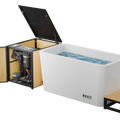
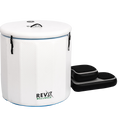
Why Have a Cold Plunge at Home?
This is the part I find most interesting about at-home wellness.
You can absolutely visit a wellness center and cold plunge occasionally.
But when the plunge is sitting right outside your door, it becomes much easier to turn something you enjoy into an actual routine.
There's no appointment.
No drive.
No membership.
No waiting for someone else's tub to become available.
You can step outside, take your plunge, warm back up and continue with your day.
And that convenience matters because wellness practices generally aren't very useful if they're so inconvenient that we rarely do them.
The Bottom Line
Cold plunging isn't magic.
But it isn't just another wellness fad, either.
We have meaningful research showing that cold-water immersion creates measurable physiological responses and can be useful for things such as post-exercise soreness and recovery. Other areas—including stress, sleep and broader well-being—are intriguing, but researchers are still figuring out exactly where cold exposure fits.
And I actually think that's exciting.
We don't have to exaggerate what a wellness tool can do in order to appreciate it.
Cold plunging can simply be one more way to intentionally create a few minutes in your day to challenge your body, step away from everything else, and build a wellness routine that works for you.
You don't need the coldest water. You don't need the longest plunge. And you definitely don't need to do what someone on social media tells you to do.
Start where you are.
Listen to your body.
And find a routine you'll actually want to come back to.
Research Behind This Article
Batista NP, et al. (2023). What Parameters Influence the Effect of Cold-Water Immersion on Muscle Soreness? An Updated Systematic Review and Meta-Analysis. Clinical Journal of Sport Medicine.
Moore E, et al. (2023). Effects of Cold-Water Immersion Compared with Other Recovery Modalities on Athletic Performance Following Acute Strenuous Exercise in Physically Active Participants: A Systematic Review, Meta-Analysis, and Meta-Regression. Sports Medicine.
De Bisschop C, et al. (2024). The effects of cold exposure on cardiovascular and cardiac autonomic control responses in healthy individuals: A systematic review, meta-analysis and meta-regression. Journal of Thermal Biology.
Singh B, et al. (2025). Effects of cold-water immersion on health and wellbeing: A systematic review and meta-analysis. PLOS ONE.
Liu S, Ma Y. (2026). Effects of cold-water immersion vs body cryotherapy on delayed onset muscle soreness and jump performance following acute strenuous exercise in physically active participants: A systematic review and meta-analysis. Medicine.
Malta ES, et al. (2021). The Effects of Regular Cold-Water Immersion Use on Training-Induced Changes in Strength and Endurance Performance: A Systematic Review with Meta-Analysis. Sports Medicine.