Benefits of an Infrared Sauna for Home Use: 2026 Guide
Share
Benefits of an Infrared Sauna for Home Use: Is It Worth It?
There is something about stepping into a warm sauna and closing the door behind you that almost immediately changes the pace of the day.
Your phone can wait.
The laundry can wait.
The emails can wait.
For the next little while, there really isn't much to do except sit, breathe and let yourself be warm.
That alone is probably part of the reason sauna bathing has been around in one form or another for thousands of years.
But infrared saunas have brought that experience into a completely different setting: our homes.
Instead of driving to a spa or gym, reserving a sauna, changing in a locker room and working the experience into someone else's schedule, you can walk into a room in your own house and use your sauna whenever it fits your life.
That's a pretty big shift.
And it leads to one of the questions I hear most often from people considering one:
Is an infrared sauna for home use actually worth it?
I think the best way to answer that is to look at two things separately:
-
What infrared sauna use may offer from a wellness perspective.
-
What changes when you have access to that sauna right at home.
Because the biggest benefit of owning a home infrared sauna may not be any single feature.
It may be how much easier it becomes to use it consistently.
Let's dig into what infrared saunas actually do, what the research says, what gets exaggerated online, and how to decide whether an infrared sauna belongs in your home.
What Is an Infrared Sauna?
An infrared sauna is a dry sauna that uses infrared-emitting heaters rather than primarily heating the surrounding air to extremely high temperatures.
Traditional Finnish-style saunas typically operate at much hotter ambient temperatures—often around 176°F to 212°F—while infrared saunas commonly operate at lower temperatures, roughly 113°F to 140°F depending on the unit and settings. A systematic review of dry sauna research described infrared cabins as generally operating around 45°C to 60°C, or approximately 113°F to 140°F.
That difference is one of the main reasons people are drawn to infrared sauna use at home.
The room doesn't necessarily need to feel unbearably hot for you to experience a warming, sweat-producing session.
For people who enjoy heat but don't love the intense air temperature of a traditional sauna, infrared can feel much more approachable.
What Are the Benefits of an Infrared Sauna at Home?
Let's start with the part everyone wants to know.
Infrared sauna research is promising, but it is also important to separate what has actually been studied from the enormous list of benefits sometimes claimed online.
Researchers have explored sauna use in relation to cardiovascular function, circulation, pain, exercise recovery, quality of life and other health measures. A systematic review examining 40 studies and 3,855 participants found generally positive results across a variety of health measures, although only 13 studies were randomized controlled trials and many individual studies were small. The authors concluded that regular dry sauna bathing has potential health benefits while emphasizing the need for better-quality research.
So there is legitimate science here.
We just don't need to turn infrared sauna into a miracle cure to appreciate it.
Here are some of the reasons people choose to make it part of their wellness routine.
1. An Infrared Sauna Can Create a True Pause in Your Day
This may sound less impressive than talking about biomarkers or circulation.
I actually think it's one of the biggest benefits.
When was the last time you sat somewhere warm for 20 or 30 minutes without trying to accomplish five other things at the same time?
An infrared sauna creates a natural boundary around your time.
You step inside.
You close the door.
And for a little while, there isn't much required of you.
You can listen to music.
Meditate.
Stretch gently.
Breathe.
Or do absolutely nothing.
Sometimes wellness doesn't need to be more complicated than that.
Traditional sauna bathing has long been associated with relaxation, and modern reviews of sauna research continue to identify quality-of-life and subjective wellness outcomes among the areas studied.
The difference with an infrared sauna at home is that relaxation becomes accessible without turning it into an outing.
And that matters more than it sounds.
2. You Can Enjoy Heat at a Lower Ambient Temperature
This is one of the clearest practical differences between infrared and traditional sauna bathing.
Some people absolutely love the intense heat of a traditional Finnish sauna.
Others walk inside and immediately think:
"How long do I have to stay in here?"
Infrared saunas generally operate at lower air temperatures because their heaters transfer radiant infrared energy rather than relying solely on heating the room to very high temperatures.
That can make the experience more comfortable for people who don't enjoy extremely hot air.
You'll still feel warm.
You'll still likely sweat.
But the environment can feel gentler and easier to settle into.
For someone hoping to make sauna use a regular part of life rather than an occasional endurance challenge, comfort is important.
You are much more likely to use something consistently when you actually enjoy being in it.
3. Sauna Heat Produces Real Cardiovascular Responses
Sitting still in a sauna doesn't mean your body is doing nothing.
Heat exposure affects circulation and cardiovascular function.
As body temperature rises, blood vessels near the skin dilate and heart rate can increase as the body works to regulate temperature.
Sauna research has explored these cardiovascular responses extensively, although it is worth pointing out that much of the large population-based research involves traditional Finnish sauna bathing, not infrared sauna specifically. Reviews have associated regular sauna bathing with several cardiovascular outcomes, while researchers continue investigating the mechanisms involved.
Infrared sauna has been studied separately as well.
For example, a systematic review and meta-analysis of sauna use in people with heart failure found short-term improvements in certain cardiac-function measures following a specific infrared sauna protocol, though the authors said more evidence was needed—particularly regarding long-term effects.
This does not mean infrared sauna is a treatment you should prescribe yourself for cardiovascular disease.
It means heat exposure creates measurable cardiovascular effects and is an active area of research.
If you have heart disease, blood-pressure issues or another cardiovascular condition, talk with your healthcare provider before adding sauna sessions to your routine.
4. Infrared Sauna May Be Appealing for Sore, Tired Bodies
Have you ever noticed how naturally we reach for warmth when something feels tight or tired?
A warm bath.
A heating pad.
A hot shower.
There's a reason warmth feels so comforting.
Heat promotes blood flow to the skin and surrounding tissues and can help create a sense of muscular relaxation.
Research on repeated dry sauna use has explored outcomes in people with various pain and rheumatologic conditions. A systematic review found promising findings related to conditions involving chronic pain and musculoskeletal discomfort, though the authors emphasized that many of the available studies were small and evidence quality varied.
An earlier review focused specifically on far-infrared sauna research described fair evidence from one study involving chronic pain, while emphasizing that the overall infrared evidence base was still limited.
That nuance is important.
An infrared sauna isn't a replacement for medical care or physical therapy.
But if warmth feels wonderful after a workout, long day or physically demanding week, a sauna can become a very enjoyable part of your recovery ritual.
5. Sweating Can Feel Incredibly Refreshing
One of the things people tend to love about infrared sauna sessions is the sweat.
And sometimes that leads straight into the word "detox."
This is an area where I prefer to be careful with language.
Your liver, kidneys, digestive system and lungs perform the heavy lifting when it comes to processing and eliminating many substances from the body.
Sweating is certainly a normal biological process, and small amounts of certain substances can be present in sweat. But broad claims that an infrared sauna "detoxifies the body" or removes specific toxins shouldn't be treated as settled medical fact.
You don't need that claim for sweating to be worthwhile.
A good sauna sweat can simply feel wonderful.
There's something incredibly refreshing about stepping out, cooling down, showering and putting on clean clothes afterward.
Sometimes the experience itself is enough.
6. A Home Infrared Sauna Makes Consistency Much Easier
This is where home ownership changes the equation.
Think about two scenarios.
Scenario One
You decide you'd like to sauna.
You need to:
Get dressed.
Drive to the gym or wellness center.
Check in.
Possibly wait for availability.
Use a shared sauna.
Shower.
Get dressed again.
Drive home.
Scenario Two
You turn on the sauna.
You go about your evening while it warms up.
You walk downstairs or into your home wellness room.
You step inside.
That's it.
It's easy to underestimate how much convenience influences behavior.
We often assume we'll use wellness services regularly because we have good intentions.
Then real life gets involved.
Work runs late.
Dinner needs to be made.
Someone has practice.
It's snowing.
You're tired.
You don't feel like driving anywhere.
Having an infrared sauna in your home removes a surprising amount of friction.
And when something becomes easy enough to do regularly, it has a much better chance of becoming part of your life.
That's one of the central ideas behind RevitaSpring: wellness doesn't have to require appointments and memberships when the experience can be thoughtfully brought home.
7. You Control the Environment
There is another underrated benefit of having an infrared sauna at home:
It's yours.
Your temperature.
Your music.
Your lighting.
Your towel.
Your schedule.
Your cleaning routine.
Your quiet.
For some people, that alone makes the experience significantly more relaxing than using a public sauna.
And modern home infrared saunas can be much more than a warm wooden box.
Depending on the model, you may find features such as:
-
Bluetooth audio
-
integrated red or near-infrared light therapy
-
chromotherapy lighting
-
app controls
-
scheduled preheating
-
panoramic glass
-
air purification
-
low-EMF heater designs
These aren't all essential.
But they can make the experience feel less like equipment and more like a genuine wellness space inside your home.
Infrared Sauna vs. Traditional Sauna: What's the Difference?
If you're researching the benefits of an infrared sauna for home use, you're probably also wondering whether you should choose infrared or traditional.
The biggest difference is how the heat is delivered.
Traditional Finnish saunas primarily heat the air around you.
Infrared saunas use infrared emitters that radiate energy toward your body while typically keeping the room at a lower temperature.
Neither approach needs to be declared the universal winner.
They offer different experiences.
Traditional sauna may appeal to you if:
You love very high temperatures.
You enjoy the classic Finnish sauna experience.
You want hot air and, depending on the sauna, the option of adding humidity with water over heated stones.
Infrared sauna may appeal to you if:
You prefer lower ambient temperatures.
You want a dry sauna experience.
You want a compact sauna for your home.
You value features such as app controls or integrated light therapy.
You find intense traditional sauna heat uncomfortable.
For many homeowners, infrared is appealing because it makes the entire experience feel simpler and more approachable.
Far Infrared vs. Full Spectrum Infrared Sauna
Here is another phrase you'll see everywhere while shopping:
Full spectrum.
Infrared energy is generally divided into near, mid and far infrared wavelengths.
Many infrared sauna cabins rely heavily on far infrared, while full-spectrum models are designed to incorporate near, mid and far infrared.
Does full spectrum automatically mean better?
Not necessarily.
Current buyer guidance correctly points out that the evidence proving meaningful additional health benefits from full-spectrum sauna over a well-designed far-infrared sauna remains limited.
So I would not choose a sauna solely because the words "full spectrum" appear on the product page.
Instead, look at the whole sauna:
-
heater quality
-
coverage
-
materials
-
EMF measurements
-
cabin size
-
warranty
-
comfort
-
controls
-
electrical requirements
-
included wellness features
That tells you much more about whether you'll love owning it.
What Makes an Infrared Sauna Good for Home Use?
If you're going to invest in an at-home infrared sauna, I would look beyond the marketing photos.
Here are the details that matter.
Low-EMF Infrared Heaters
EMF stands for electromagnetic field.
Electrical devices naturally create electromagnetic fields, but some people prefer wellness equipment specifically designed to reduce exposure.
If this matters to you, don't settle for a vague badge that simply says "low EMF."
Look for actual measurements when manufacturers provide them.
For example, RevitaSpring's Wizzisaunas S01 Low-EMF Infrared Sauna uses carbon-crystal far-infrared heaters and lists independent measurements as low as 1.2 mG.
The larger Wizzisaunas S07 2–3 Person Infrared Sauna has published independent measurements as low as 0.3 mG.
Numbers and testing are more useful than marketing adjectives.
Sauna Materials Matter More Than Most People Realize
You are going to sit inside your sauna while it gets warm.
That makes materials worth paying attention to.
Look at:
-
wood species
-
adhesives
-
stains
-
finishes
-
metal components
-
composite materials
-
interior treatments
This is actually one of the reasons I chose certain Wizzisaunas models for RevitaSpring.
The one-person S01, for example, uses Canadian Red Cedar along with a food-grade water-based wood finish, plant-based near-zero-formaldehyde adhesives and food-grade 304 stainless steel components.
Those aren't glamorous specifications.
But they're exactly the kind of details I want to know when something is going into a heated wellness environment in my home.
Which RevitaSpring Infrared Sauna Is Right for You?
This depends much more on how you plan to use your sauna than on which one has the longest specification list.
Here are a few ways I would think about it.
If You Want a Personal One-Person Sauna
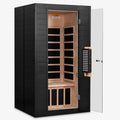
The Wizzisaunas S01 Low-EMF Infrared Sauna is a beautiful option for someone creating a dedicated personal routine.
It uses Canadian Red Cedar, low-EMF carbon-crystal far-infrared heaters, integrated four-wavelength light therapy and app control. Its compact footprint makes it much easier to work into a bedroom, home gym or wellness room than a larger shared sauna.
I particularly like this option for the person who knows:
"This is my quiet time."
You aren't paying for extra seating you don't need.
You have your own little retreat.
If You Want a More Open, Modern Feel
Some people love the cocoon feeling of a wood sauna.
Others immediately think:
"I need more windows."
For the second group, the Wizzisaunas 909MX Panoramic Infrared Sauna is worth looking at.
It uses three-sided tempered glass to create a 270-degree panoramic design while keeping a compact one-person footprint. It also includes six low-EMF carbon-crystal heaters, integrated four-wavelength light therapy and app controls.
This is one I particularly like for modern interiors because it feels lighter visually.
A sauna doesn't have to look like something you hid in the basement.
It can become part of the room.
If You Want a Sauna for Two
If you can picture yourself sauna bathing with your partner—or you simply want more room—the Wizzisaunas S02 2-Person Infrared Sauna gives you that extra space.
It's available in Canadian Red Cedar or Hemlock and includes low-EMF carbon-crystal heaters, four-wavelength integrated light therapy and smartphone controls.
I also think there's something really nice about wellness not always being a solitary activity.
Maybe sauna time becomes where you and your spouse actually talk at the end of the day.
No phones.
No TV.
No distractions.
Just twenty minutes together.
That has value too.
If You Want More Room for Two or Three People
The Wizzisaunas S07 2–3 Person Infrared Sauna has a distinctive pentagon layout that creates more usable interior room.
It's available in Canadian Red Cedar or Hemlock and includes low-EMF infrared heat, integrated light therapy and smart-app controls.
This is a better match if you're creating a larger home wellness room or know multiple members of the household are going to use the sauna.
If You Want Full-Spectrum Infrared + Dedicated Red Light
Another option is RevitaSpring's Neptune Full Spectrum Infrared & Red Light Therapy Sauna.
The Neptune combines near-, mid- and far-infrared heating with a dedicated 660nm red and 850nm near-infrared light system in a compact one-to-two-person cabin.
It also includes Canadian Hemlock construction, chromotherapy lighting, Bluetooth audio and an air-purification system.
For someone who wants several wellness technologies integrated into one space, that's an appealing combination.
Is an Infrared Sauna at Home Worth the Cost?
This is the real question.
And the answer is personal.
A home infrared sauna isn't a small impulse purchase.
But neither are years of sauna sessions, spa appointments or wellness memberships.
The more useful question may be:
How often would you realistically use it?
Let's say you love sauna bathing but currently go once every few weeks because getting there is inconvenient.
If owning one means you start using it three or four times a week, you're not really comparing:
"sauna versus no sauna."
You're comparing:
occasional access versus everyday access.
That's a completely different value proposition.
The same is true with many home wellness tools.
Convenience changes consistency.
Consistency changes how much value you receive from the equipment.
And because a well-made infrared sauna can become part of your home for years, the cost makes more sense when you evaluate it as a long-term wellness investment rather than a one-time spa purchase.
How Often Should You Use an Infrared Sauna?
There is no universally established perfect frequency.
The 2018 systematic review of dry-sauna research specifically noted that more research is needed to determine ideal frequency and duration for different health outcomes.
That means I'm cautious anytime someone announces that everyone "must" sauna a certain number of days per week for a specific result.
For general wellness, start conservatively.
If you're new to infrared sauna use, shorter sessions at a comfortable temperature give you an opportunity to learn how your body responds.
Follow the instructions for your particular sauna.
Stay hydrated.
And don't turn your session into a contest.
The longest, hottest sauna session is not automatically the best sauna session.
When Is the Best Time to Use an Infrared Sauna?
This is another question with no universal answer.
Some people love sauna sessions in the morning because they enjoy beginning the day with warmth and quiet.
Others prefer sauna after exercise.
And a lot of people love it in the evening because it becomes the dividing line between:
"The day is still happening."
and
"I'm finished for the night."
If you're purchasing a home sauna, this is worth thinking about before deciding where to put it.
Place it somewhere that supports the routine you actually want.
If you envision using it after workouts, your home gym may be perfect.
If you want it to become part of your nighttime routine, placing it somewhere near your bedroom or bathroom may make more sense.
Design the environment around your life.
Can Infrared Sauna Help You Lose Weight?
This question comes up constantly.
You may see the number on the scale temporarily drop after a sweaty sauna session.
That is largely because you've lost water, not because you've suddenly lost a meaningful amount of body fat.
Once you rehydrate, much of that weight returns.
An earlier review of far-infrared sauna research characterized evidence relating to obesity as weak.
So I would not buy an infrared sauna as a weight-loss machine.
Movement, nutrition, sleep and long-term lifestyle patterns matter far more.
If sauna use supports a broader routine that makes you feel good and helps you take better care of yourself?
Wonderful.
But that's a very different claim.
Does Infrared Sauna "Detox" the Body?
As I mentioned earlier, I would be wary of exaggerated detox promises.
Sweat is one route through which the body releases water, salts and small quantities of other compounds.
But your body's primary detoxification and elimination systems include the liver, kidneys, lungs and digestive tract.
Infrared sauna can help you sweat.
And that can feel fantastic.
You don't need to claim that sweat is removing every toxin from your body to make sauna worthwhile.
Is an Infrared Sauna Safe?
For many healthy adults, sauna bathing is generally well tolerated when used appropriately.
The systematic review of repeated dry sauna use reported mostly mild adverse effects in the included studies, such as heat discomfort, lightheadedness and low blood pressure.
But heat is still a physiological stressor.
Use extra caution if you:
-
have cardiovascular disease
-
have low blood pressure or a history of fainting
-
are pregnant
-
take medications that influence blood pressure, sweating or temperature regulation
-
have difficulty regulating body temperature
-
have another medical condition that could make heat exposure risky
If you're unsure, talk with your healthcare professional before starting.
And avoid sauna use when you're dehydrated or impaired by alcohol.
Hydration matters before and after your session.
What Should You Look for Before Buying an Infrared Sauna for Home?
If you've decided the benefits and convenience make sense for you, I would compare these things before ordering:
1. Size
One person?
Two?
Three?
Be realistic.
A one-person sauna may be perfect if you're almost always going to use it alone.
A larger sauna may be worth the additional footprint if you want to share the experience or simply like more interior space.
2. Heater Design
Look at the type, placement and coverage of the infrared heating panels.
You want an even, comfortable experience—not one extremely hot spot and a cold corner.
3. EMF Information
If low-EMF design is important to you, look for measurable specifications rather than vague claims.
4. Materials
Know what kind of wood you're sitting inside.
Ask about adhesives, finishes and treatments too.
5. Electrical Requirements
This isn't glamorous, but check it before your sauna arrives.
Different models have different power requirements.
6. Door and Room Clearance
Measure the actual space.
Then measure it again.
Consider:
-
ceiling height
-
door swing
-
nearby outlets
-
ventilation
-
access for assembly
-
walking space around the sauna
7. Warranty
A sauna should be something you expect to use for years.
The company standing behind it matters.
8. The Features You Will Actually Use
Bluetooth sounds wonderful.
App controls can be incredibly convenient.
Integrated red light therapy may appeal to you.
Panoramic glass can make the cabin feel much more open.
But don't pay for twenty features just because they're there.
Think about your real life.
What will make you excited to turn the sauna on?
That's what matters.
Frequently Asked Questions About Home Infrared Saunas
Are infrared saunas good for home use?
Yes, infrared saunas are particularly well suited to home wellness setups because they generally operate at lower ambient temperatures than traditional Finnish-style saunas and are available in compact one-, two- and multi-person designs. Electrical and installation requirements vary by model, so always check specifications before purchasing.
Is it worth having an infrared sauna at home?
It may be if sauna use is something you genuinely enjoy and plan to use regularly. The main advantage of ownership is convenience: no appointments, memberships or travel are required, making regular sauna use much easier to maintain.
What are the main benefits of an infrared sauna?
Infrared sauna provides whole-body heat exposure at comparatively lower ambient temperatures. Research has explored sauna use in relation to cardiovascular function, circulation, pain, quality of life and other outcomes, although evidence quality differs considerably by outcome and sauna type.
Is infrared sauna better than traditional sauna?
Neither is universally better.
Traditional Finnish sauna uses hotter air, while infrared sauna uses radiant infrared energy and typically operates at lower ambient temperatures.
The best choice depends heavily on which experience you prefer.
Does an infrared sauna make you sweat?
Yes. Infrared sauna sessions commonly cause sweating as the body responds to heat.
Can you use an infrared sauna every day?
Some people use sauna frequently, but there is not one scientifically established schedule appropriate for everyone. Follow your sauna manufacturer's guidance, begin conservatively and consider your individual health circumstances.
How long should you stay in an infrared sauna?
Follow the recommendations for your specific sauna. New users should generally start with shorter, comfortable sessions rather than immediately attempting long heat exposures.
Do infrared saunas help with recovery?
Heat can increase circulation and promote a subjective sense of muscular relaxation. Sauna research has explored pain, exercise and musculoskeletal outcomes, but specific effects vary and sauna should not replace treatment for an injury or medical condition.
What is the best wood for an infrared sauna?
Canadian Red Cedar and Hemlock are both common quality choices.
Cedar is aromatic and naturally moisture resistant.
Hemlock has a lighter appearance and less noticeable aroma, which some people prefer.
Construction quality and finishes matter in addition to wood species.
Is low EMF important in an infrared sauna?
Some consumers prioritize low-EMF equipment. If that matters to you, look for manufacturers that provide actual tested measurements rather than relying exclusively on a "low EMF" marketing statement.
Can an infrared sauna include red light therapy?
Yes.
Some modern infrared saunas combine infrared heating with dedicated red and near-infrared light systems.
These are separate technologies even though near-infrared light and infrared sauna terminology can sound similar.
The Benefit I Think Matters Most
After looking at all the research and all the features, I keep coming back to something much simpler.
An infrared sauna creates a place to take care of yourself.
Not someday.
Not when you finally have a free weekend.
Not when the spa has an opening.
Today.
Maybe you walk into it after dropping everyone where they need to go.
Maybe you use it after your workout.
Maybe you turn it on after dinner, put on your favorite music and give yourself twenty quiet minutes.
Maybe it becomes the place where you finally stop carrying the day around with you.
That's the part of home wellness I love.
The equipment isn't supposed to become another responsibility.
It's supposed to make taking care of yourself easier.
And when your wellness tools are sitting right there in your home, ready when you are, the distance between wanting to create a healthier routine and actually living one becomes much smaller.
That is why I created RevitaSpring.
I want the products I choose to help people create homes that don't just look beautiful—but feel restorative too.
So if you're considering bringing an infrared sauna into your home, don't choose one simply because it has the biggest heater or the longest feature list.
Think about where you'll put it.
Think about when you'll use it.
Think about whether you want your own quiet one-person retreat or a space you can share.
Pay attention to the materials, heater quality and construction.
And choose the sauna that makes you think:
"I can actually see myself using this."
Because ultimately, the best infrared sauna isn't the one you admire online.
It's the one that becomes part of your life.
Explore Infrared Saunas for Home Use
If you're ready to compare options, explore RevitaSpring's collection of thoughtfully selected infrared saunas for personal, shared and full-spectrum home wellness.
From compact one-person cabins to spacious two- and three-person designs, I've chosen options based on the same things I would care about in my own home: thoughtful construction, quality heating technology, usable features, materials and an experience you'll genuinely look forward to.
And if you're not sure which sauna is right for your space, reach out.
I'm always happy to help you compare your options.
I'd rather help you choose the sauna you'll love for years than simply tell you to buy the most expensive one.
Research Referenced
Hussain J, Cohen M. Clinical Effects of Regular Dry Sauna Bathing: A Systematic Review. Evidence-Based Complementary and Alternative Medicine. 2018.
Beever R. Far-infrared saunas for treatment of cardiovascular risk factors: Summary of published evidence. Canadian Family Physician. 2009.
Kihara T, et al. Research summarized in systematic reviews examining infrared sauna/heat therapy and cardiovascular outcomes.
Laukkanen JA, Laukkanen T, Kunutsor SK. Cardiovascular and Other Health Benefits of Sauna Bathing: A Review of the Evidence. Mayo Clinic Proceedings. 2018.
Please note that sauna research includes multiple forms of heat therapy, and findings from traditional Finnish sauna studies should not automatically be assumed to apply identically to infrared sauna use.
This article is for general educational purposes only and is not medical advice. Infrared saunas sold by RevitaSpring are general wellness products and are not intended to diagnose, treat, cure or prevent disease. Consult a qualified healthcare professional before sauna use if you are pregnant, have a medical condition, take medications that affect temperature regulation or blood pressure, or have concerns about heat exposure.